


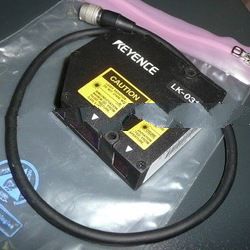

 Click for original picture
Product detail:Characteristics:
Linearity of ±0.1% of F.S. (All models)
Resolution of 1 µm (LK-031)
30 µm diameter beam spot (LK-031)
Ultra long measuring distance up to 750 mm (LK-long Series)*
Measurement unaffected by color, surface texture or stray light
Measuring range:
- High-precision (LK-031)
- - 30 ±5 mm
- Standard (LK-081)
- - 80 ± 5 mm
- Long-distance (LK-501/503)
- - 350 ±100 mm
- - 500 ±250 mm
- Description
Highly accurate measurement
Utilizing a newly developed CCD as the light-receiving element and a 32-bit ultra-high speed RISC processor for signal processing, the LK series provides highly accurate measurement regardless of target surface properties. The LK-031 delivers a resolution of 1 µm and linearity of ±0.1% of F.S.
Visible laser beam spot of 30 µm diameter
KEYENCE's unique optical system minimizes lens aberration to give the LK-031 a minimum spot diameter of 30 µm. This enables the surface contour of a target to be accurately measured.
Unbeatable maximum range of 750 mm (LK-long Series)NEW
In long range mode, the measuring range of 500 mm ±250 mm provides the capability for almost any application.
Unbeatable maximum range of 750 mm
Stable measurement of various target surfaces
The patent-pending LFTC circuit enables measurement of multicolored or patterned targets. Low reflective targets, such as black rubber, can be measured without additional adjustment.
Sensor head is rated IP-67
Get accurate measurement even in harsh environmental conditions such as in the manufacturing process.
Measurement principle
The CCD laser displacement sensor uses a triangulation measurement system.
Conventional laser-displacement sensors employ a PSD (Position Sensitive Detector) as the light-receiving element. However, the LK series uses a CCD as the light-receiving element.
The light reflected by a target passes through the receiver lens that focuses the light on the PSD or CCD.
PSD-type sensors use the light quantity distribution of the entire beam spot on the PSD to determine the beam spot center and identify this as the target position. However, the distribution of light quantity is affected by the surface condition of the target, causing variations in measured values. The CCD detects the pixel where the peak value of the light quantity distribution of the beam spot identifies this as the target position. Therefore, the CCD enables stable, highly accurate displacement measurement, regardless of the light quantity distribution of the beam spot.
