


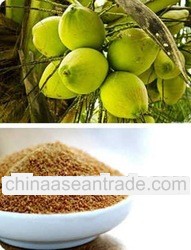

 Click for original picture
Product detail:
Coconut sugar (also known as coco sugar, coconut palm sugar or coco sap sugar) is a sugar produced from the sap of cut flower buds of the coconut palm. Coconut sugar has been used as a traditional sweetener for thousands of years in the South and South-East Asian regions where the coconut palm is in abundant supply. The world's largest producer of coconut is the Philippines.[1]
In some areas, predominantly in Thailand, the terms "coconut sugar" and "palm sugar" are often used interchangeably. However, coconut sugar is different both in taste, texture and manufacture methods from palm sugar, which is made from the sap in the stems of the Palmyra palm, the date palm, the sugar date palm, the sago palm or the sugar palm.
Health benefits
The Glycemic Index of coconut sugar is 35 and is classified as a low glycemic index food.[4] It is considered to be healthier than traditional white sugar and brown sugar.[5] It can be used as a 1:1 sugar substitute for coffee, tea, baking, and cooking.
Coconut sugar has a high mineral content, being a rich source of potassium, magnesium, zinc, and iron. In addition to this it contains Vitamin B1, B2, B3, and B6. When compared to brown sugar, coconut sugar has 36 times the iron, four times the magnesium, and over 10 times the amount of zinc.[6]
The coconut sap, from which which coconut sugar is derived, contains 16 amino acids. The amino acid which has the highest content in coconut sap is Glutamine.
Popularity
Coconut sugar has gained popularity as a health food and among people with diabetes.[5] Coconut sugar can be used as a sugar substitute[7] and is considered safe to use for diabetics. Coconut sugar used to be only sold in specialty Asian stores but companies are now selling it in natural food markets and online making coconut sugar more accessible to mainstream markets and making it a more viable sugar substitute.
