


 Click to enlarge
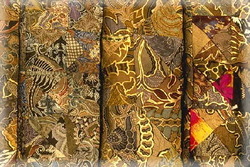
Batik is generally thought of as the most quintessentially indonesian textile. Motifs of flowers, twinning plants, leaves buds, flowers, birds, butterflies, fish, insects and geometric forms are rich in symbolic association and variety; there are about three thousand recorded batik patterns.

The patterns to be dyed into the the clothe are drawn with a canting, a wooden 'pen' fitted with a reservoir for hot, liquid wax. In batik workshops, circles of women sit working at clothes draped over frames, and periodically replenish their supply of wax by dipping their canting into a central vat. Some draw directly on the the cloth from memory; others wax over faint charcoal lines.

This method of drawing patterns in wax on fine machine-woven cotton was practiced as a form of meditation by the female courtiers of central java; traditionally, batik tulis(tulismeans 'write' in indonesian) is produced by women.

In the 19th century, the application of waxed patterns with a large copper stamp orcap saved the batik industry from competition with cheap printed european cloth. The semi-industrial nature of cap work allows it to be performed by men. Batik motifs recall characters from the hindu epics, plants, animals, sea creatures and gamalan melodies.

Batik dresses are worn for several purposes, such as:

1. Informal dresses
It is a free choice, usually for daily casual wear.

2. Formal occasions
In some parties, as a state banquets, receptions, etc, the invitees are requested to wear batik. Long sleeves shirts for the men and 'kain batik'(longbatik to cover the lower body) for the women.

3. Traditional occasions
It is worn to present the traditional wedding ceremonies, special ceremonies for the royal families, etc.
Similar products