

 Verified Company
 Dongguan Mingcheng Electronic Technology Limited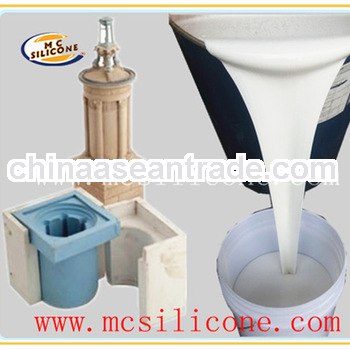

 Click to enlarge
Description of Tin-Base Mold Making Condensation Silicone Rubber
Tin-Base Mold Making Silicone Rubber , also called condensation cure silicone, are two- component materials which can cure at room temperature to flexible, high tear-strength rubbers. Tin cured silicone can be poured onto models or they can be made brushed by adding a thixotropic additive. They are ideal for molds where easy release or high temperature resistance (Max 200 °C) is required.
Specifications of MC RTV-2 Silicone Rubber
Room Temperature Vulcanization
Equipped with REACH certificate
Professional technician with rich experience
4% catalyst offers for free of charge
Silicone hardness range: 10-60 shore A
High duplicating silicone molds
Characteristics of Tin-Base Mold Making Condensation Silicone Rubber
Tin-Base Mold Making Condensation Silicone Rubber is white flowing liquid with general hardness of 15-60 shore A after curing. Molding silicone rubber is a kind elastic silicone rubber mold which features with resistance to deformation, high-temperature, acid-alkali and expansion as well as high reproduction times, good tensile strength ,tear strength and elongation, Stripping the gender is good, Linear shrinkage rate low, Size stability is good.
Applications of Tin-Base Mold Making Condensation Silicone Rubber
Tin-Base Mold Making Condensation Silicone Rubber can be used for casting polyurethane, epoxy, polyester resin, PU resin, cement, plaster, gypsum, candle, soap, waxes, toys crafts, poly resin crafts, Lighting, plastic toys, stationery gifts, statue, relieve furniture, furniture decorative materials, artificial stone, building decoration material, sculpture, sandstone, low melt alloys/metals, urethane and so on .
RTV-2 silicone rubber can be applied in many objects mold making, since the RTV-2 silicone has good flow ability and medium hardness, and the silicone can cure at room temperature, thus it's a good material for duplication.
RTV-2 Silicone rubber can be used for artificial stone mold making. For example, RTV2030, RTV2066 and RTV2088 silicone.
RTV-2 Silicone rubber can be applied in candle and soap mold making, such as RTV215 and RTV218 silicone.
RTV-2 Silicone rubber can be used for plaster mold making, such as RTV2025, RTV2028 and RTV2030 silicone.
RTV-2 Silicone rubber can be applied in the field of shoe sole mold making, for example, RTV3010 and RTV3015 silicone.
RTV-2 Silicone rubber can be used for prototyping and electronic potting.
Data of of Tin-Base Mold Making Condensation Silicone Rubber
Tin condensation Rubber series
P Item NO. | Characteristics before curing | Curing | ||||||||
Part A | Part B | Part A+ Part B | Pot life at 250C mins | De-molding Time at 250C | ||||||
Appearance | Ratio | Viscosity cps | ||||||||
RTV2015 | Liquid white | Liquid clear | 100:2 | 25000-26000 | 30-40 | 4-6 H | ||||
RTV2020 | Liquid white | Liquid clear | 100:2 | 24000-25000 | 30-40 | 4-6 H | ||||
| Characteristics after curing 24 hours | |||||||||
Hardness Shore A | Tear strength (N/mm) | Tensile Strength | Elongation break (%) | Linear Shrinkage | ||||||
RTV2015 | 13-15 | 25 | ≥3.8Mpa | 600 | ≤0.3% | |||||
RTV2020 | 18-20 | 25 | ≥3.8Mpa | 550 | ≤0.3% | |||||
Note: The TDS is just for reference, we can accord customer’s requirement to adjust the color, viscosity and hardness.
Instructions for making silicone molds
1. Make sure the surface of the original is clean and free of loose material.
2. Weight 100 Part A base and 2 parts of CA30 Curing Agent in a clean container.
3. Stir Part A base silicone before use thoroughly , as filler separation may occur upon prolonged storage.
4. Mix Part A and Part B evenly until the CA30 completely dispersed in the base.
5. Pour the mixed Part A base silicone and CA-30 curing agent as soon as possible onto the original
6. De-mold after 24 hours, it will improve the replicate times of silicone mold.
Note: It is strongly recommended that entrapped air be removed in a vacuum chamber, allowing the mix to completely expand and then collapse. After a further 1-2 minutes under vacuum, the mix should be inspected and can be used if free of air bubbles. A volume increase of 3-5 times will occur on vacuum de-airing the mixture. So a suitably large container should be chosen.
The information above is just for reference, if you're interested or have any questions, please feel free to contact Nicole:
Web:www(dot)mcsilicone(dot)com
E-mail:nicole(at)mcsilicone(dot)com
Skype:nicoleszmc
MSN: nicoleszmc (at)hotmail(dot)com