

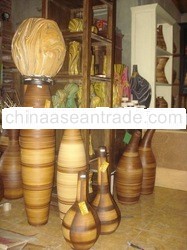

 Click to enlarge
There is long history of Indonesians using Terracotta and ceramics for both household use and statuary dating back to the Majapahit period more than 800 years ago. Archaeological excavations continue to unearth basic household items made from these materials that are many centuries old.
The soil that is the basis for terracotta is usually taken from height well above sea level often from the slopes of mountains. Once dried, the soil is beaten until it becomes smooth and then soaked in water. This wet clay-like material is mixed with fine , dry earth and molted into various shapes for many uses.
The availability of the basic clay substance is widespread throughout Indonesia, particularly in parts of java and Lombok and to a lesser extent, Bali. In Bali it is most often used as ornamentation on the roofs of temples and houses, as well as decorative wall panels or simple oil lamps.
In java and Lombok , however, thousands of people are employed in the making of terracotta items ranging from small candleholders to large garden pots. In lombok there are approximately 3,000 craftpeople producing terracotta items and probably as many part-time workers.
In Java , terracotta is baked in ovens to temperature of 1,000 degrees whereas Lombok terracotta still employs the traditional method of baking in ground ovens where temperatures reach no more then 400 degrees. Despite the traditional method of production , it is probably in Lombok that terracotta production reaches its highest level of creativity in Indonesia.
For further information , please call us.
Note :
Article from : Made in Indonesia book edition 2005
Please dont hesitate contact us by email or sms to +628176359168 / 08176359168 for further information.
We'll response quickly on blackberry.
Thank you very much.
Warm regards
Donny from Prambanan Indonesia Group